
At the time of my writing this, Pope Francis is in the hospital with bilateral pneumonia. While I hope and pray for his health to improve, I can’t help but reflect on the impact his life has had on mine.
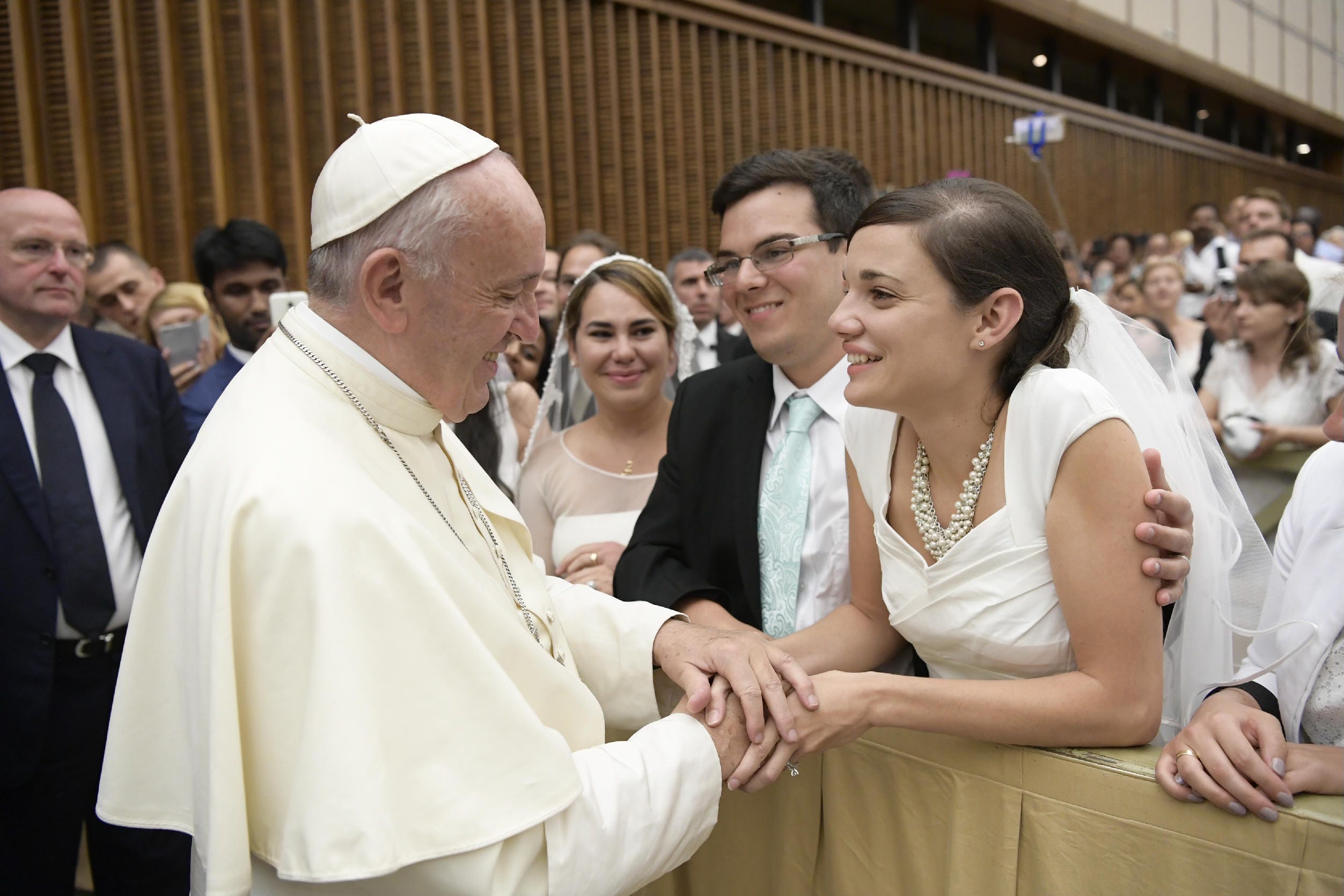
The Encounter
We met only once, and very briefly. I would like to say we exchanged words, but I was literally speechless — and not because I was starstruck. On the day I had the opportunity to meet and speak with the Holy Father, I woke up with no voice.
I don’t mean I had a raspy voice. I mean I could not speak a single word. That didn’t stop me from trying. I honestly believed my voice would come back when I was face to face with him. Full of faith, I gave it my best effort. “P—. P—! P—fff!!” To my dismay, instead of saying his name, I ended up simply panting in his face like a dog, with my tongue out, watching little drops of my spit land on his white vestments.
Horrifying. And yet, there was a silver lining. If you know anything about this pope, you know he has a soft spot in his heart for anyone suffering. I’m reminded of one famous moment in 2013 when Francis spotted a man in the audience with deformities and open sores on his face, walked right up to him, and embraced him. When the man was interviewed about it later, he described the moment as ‘paradise’ and said what struck him most was how the pope didn’t even hesitate.
In his case and mine, this endearing quality of Pope Francis really paid off. As the Holy Father was moving down the line of adoring people, he spent between five and ten seconds with each. But perhaps thinking I was suffering from some sort of disease that caused me to pant and spit, he stayed with me for at least a full minute. Everybody else was so jealous. He held my hand and smiled at me, keeping eye contact, sharing the warmth of his spirit with me. I couldn’t explain to him why my voice was gone. So I just tried to be present and accept it.
Finally, he turned to my wife, who was standing next to me. Her voice was working just fine (thank God) so she was able to speak with him. She omitted the request for intercession for the New York Yankees, which is something she knew I wanted to ask him for. But she said all we really needed to say.
“Pope Francis, we’re praying for you.”
This was a pivotal moment. He seemed deeply moved. He closed his eyes, smiled, and squeezed our hands. You can see this in the image above. We were kindred spirits in that instant. We were strength for one another. We were brothers and sister, community. Then he responded, “I need.”
A Pope of Contradictions
This response strikes me as deeply now as it did then. His voice was tender and his tone was heartfelt.
His face was a canvas of contradictions—alight with joy yet shadowed by sorrow. There was energy and zeal, but also weariness. I could see the fire of purpose burning alongside the quiet ache of sacrifice. It was a beautiful paradox; two opposing forces coexisting in delicate harmony.
This brought me so much comfort, as a person who is also known to embody a contradiction or two.
What I’m offering here is not a full defense of everything Pope Francis has ever said and done. But over the years I’ve heard so many people talk about his contradictory ways in a solely negative light. He confuses people with statements that, at times, lack precision. And much of the criticism he’s received for that is understandable. For me personally, if I remember Pope Francis as a man of duality, as a walking paradox, it will be because of what I saw in his face and heard in his voice when I encountered him.
I learned from this pope. And not just from him as a pope, but from his as a person. I prayed better after my encounter with him. For that gift alone, I will be forever grateful.
My Takeaways
First, his simple response was so powerful because it was so humble. To say ‘I need’ is to reject self-sufficiency and stand exposed in the raw light of dependence. It is an admission that we are not whole on our own, that we hunger, that we lack. And yet, in that vulnerability lies a subtle strength—for only those who dare to need can truly receive.
In addition to being humble, his response was honest. Honesty and authenticity are at the heart of Christian life. Sadly, many Christians feel the pressure to be ‘perfect’. I’ve been there and done that. If there was ever a place where you could express your real self, unencumbered by fear of judgement, it should be church—and yet it’s a place where so many of us show up and pretend.
We are, all of us, walking contradictions. What if this is not a flaw in our design, but rather simply what it means to be human?
For example, as I write this, I’m sitting on a small island in British Columbia, just north of Vancouver. I long for the adventure of climbing the snowcapped mountains in the distance, but I’ve also gone to considerable lengths to make sure I’m warm and comfortable by the fire. I’m attending a retreat for artists, writers, and creatives. I love being in the presence of the people on this retreat, yet there’s a session happening in the main room right now and I’m cherishing solitude in my cabin.
Some would say this makes me a hypocrite. We often feel pressured to pick a side—be one thing or the other, hot or cold, all gas or all brakes. But it seems to me that God did not make us that way
Christ Himself was the ultimate paradox. The King who washed feet. The Lion who became the Lamb. He was omnipotent, yet weary; sovereign, yet submitted to death.
If He, who was perfect, embraced contradiction, then surely we—who are far from perfect—don’t need to be afraid of it. Maybe paradox is not disorder but design.
Okay, I’ve established that we are all complicated and full of contradiction. So why was this particular meeting with Pope Francis so impactful for me?
Catholics believe that while Jesus is the head of the Church, the pope is the visible head, the vicar (or representative) of Christ on Earth.
At the time of this visit, I was not particularly enjoying the grandeur of Rome. The large, imposing structures didn’t feel sacred to me. The churches felt more like monuments or museums, and I was bothered by the feeling they left me with—the burning question of whether or not Jesus would like any of this. There was so much lavishness on display in gold and priceless art, while the streets just outside were full of the poor and needy. I’ve done a lot of processing around that. It’s another conversation for another time, but suffice to say, I was not in a good headspace as it relates to the institutional Church when I went to meet its leader.
I’m so thankful that when I encountered him, he did not enter the room like a king, but rather like a servant. He did not feel the need to pretend to be anything other than a simple man trying to live out the call God placed on his life with joy, even though it was clearly taking a heavy toll on him. He only spoke two words, but said so much. I can’t overstate how much permission this gave me to be myself—to be who I am, where I am, and yet to reach toward greater heights.
When I met him, Pope Francis radiated the ‘joy of the Gospel’—the title of his 2013 apostolic exhortation (Evangelii Gaudium in Latin). If you want to know more about the joy of the Gospel, go read it. His writing will be more beneficial to you than mine will.
Though the encounter was brief, I feel that I met the real man. I hope to live my life with the same grace, the same resilience, the same paradox of faith: a joy that persists even in suffering, a love that endures even when it costs us something, and a willingness to say, I need, so that I may find strength.
This is wonderful!